
How much of your supply chain planning still happens outside your ERP?
Nobody answers “none.”
Most people laugh, then guess low – because the work that happens outside the system is exactly the work nobody reports on.
You already know what it looks like. There is a spreadsheet. It has a version number and somebody’s initials in the filename, and it gets opened every Monday morning before anyone commits to anything. There is a whiteboard in the planner’s office with next week’s production sequence on it, and that sequence exists nowhere else. There is a clipboard on the receiving dock. And there is a group chat where the expedites actually get agreed.
The ERP holds the record. The spreadsheet holds the decision.
Then there is the part nobody puts in a slide: it usually runs on one or two people. They built the workbook. They know which tabs matter, which formulas to trust, and which numbers to quietly ignore. They are normally very good at their jobs — which is exactly why nobody challenges the process.
Ask what happens when they are on vacation, and you get a pause. Ask what happens when they leave for good, and you get a different kind of pause.
The second cost is visibility. Leadership reads the number in the system. Operations works to the number in the sheet. Both are reported honestly. They do not match, and the meeting spends its first twenty minutes reconciling instead of deciding. Three weeks later, when someone asks why you ordered that much, nobody can reconstruct it — because the reasoning lived in a cell that has since been overwritten.
And you cannot test anything. Want to know what happens if your biggest customer moves a launch by a month? That is not a scenario you can run. That is a weekend rebuilding the workbook.
Here is the part most vendors get wrong. The spreadsheets are not a discipline problem, and the people using them are not the problem either. They exist because they work. They are faster than the system, more flexible than the system, and they were usually built by someone who understood the business better than whoever configured the process five years ago.
They are not a failure. They are a map.
Each one marks a place where the process outgrew the setup, or the business changed and the configuration did not, or something genuinely useful was never switched on in the first place.
So, the useful exercise is not banning Excel. It is counting the spreadsheets and then asking three questions of each one. Why does this exist? Who is the only person who can run it? And what breaks tomorrow if they are unavailable?
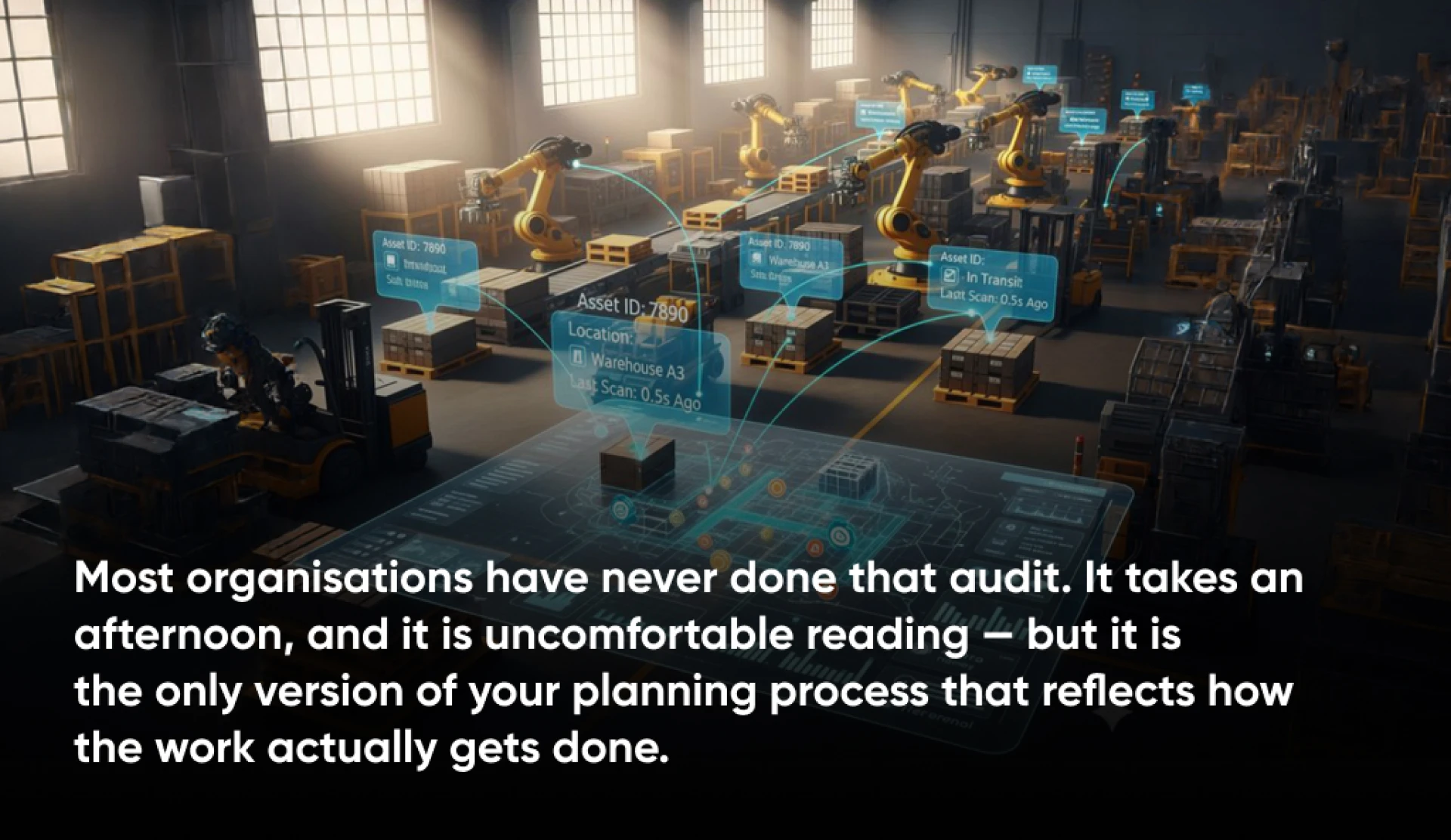
Most organizations have never done that audit. It takes an afternoon, and it is uncomfortable reading – but it is the only version of your supply chain planning process that reflects how the work gets done.
We are at the Microsoft Community Summit in Nashville, 11–15 October, with a board on our stand posing exactly this question. Come and put a sticky note on the step that hurts most.
CES helps organisations bridge the gap between the ERP they own and the planning processes they use. By combining deep supply chain expertise with Dynamics 365, data, and AI capabilities, we help businesses turn spreadsheet-driven decisions into transparent, repeatable, and scalable processes without losing the flexibility that made those workarounds valuable in the first place.

About the Author
Sunny Sharma is business analyst with 10+ years of work experience in multiple domains with specialization in Microsoft Dynamics 365 Finance & Operations as well as a Professional Scrum Master (PSM) Certified with exposure to systems and domains like manufacturing, insurance, banking, telecom and FMCG. I bridge the gap between the business stakeholders and scrum team to accomplish the tasks that business needs.